
The most powerful sales channel in the history of commerce was never an ad. It was never a search result. It was one person leaning toward another and saying, "Call this guy — he's good." No pitch. No skepticism. The deal was half-closed before the first conversation even started. Word-of-mouth has always won. It just had one weakness: it couldn't scale. That part just changed.
Every founder knows the feeling. A customer shows up already warm — they heard about you from someone they trust, and they arrive wanting to say yes. You don't have to convince them you're real. Someone already did that for you. Compare that to a cold lead you fought to get through search and ads, and the difference is night and day. One you drag across the finish line. The other walks across it on their own.
So here's the question worth sitting with: if word-of-mouth is the best channel we've ever had, why has every business spent the last twenty years chasing rankings instead?
Why Word-of-Mouth Always Won
A recommendation isn't information. It's transferred trust. When a friend vouches for a plumber, a lawyer, a bakery, they're not describing a service — they're lending you their own credibility. The risk you'd normally carry evaporates, because someone you believe in already carried it for you.
That's why a referral converts like nothing else. There's no persuasion step. The prospect skips straight past the part where they wonder if you're a scam, if you'll disappear, if the reviews are fake. Trust was pre-installed by a source they don't doubt. It's the same mechanism that makes certain businesses feel safe the instant you hear about them — we unpack exactly why in the psychology of being chosen.
Insight
You can't buy transferred trust. That's the whole point. A paid ad says "trust me." A recommendation says "someone you already trust vouches for them." Those are not the same sentence, and buyers can tell the difference instantly.
This is the channel businesses dream about. No ad spend. No bidding war. No decade-long climb up the rankings. Just a warm name passed from one person to the next. The problem was never whether word-of-mouth worked. The problem was that you couldn't turn it on.
The Ceiling Nobody Names
Word-of-mouth has a hard ceiling, and it's made of human limits. It depends on who happens to know you. On whether they happen to remember you at the exact moment someone asks. On whether they happen to be in the right conversation at the right time. Three coincidences stacked on top of each other — and if any one of them misses, the recommendation never happens.
Your best customer loves you. But she only talks to so many people. She only remembers you when something jogs her memory. And she's only in a handful of conversations a week where your name would even be relevant. Multiply that across everyone who likes your business, and you get a channel that's extraordinary in quality and tiny in reach. A fire that burns bright and small.
That ceiling is why most businesses gave up on word-of-mouth as a strategy and treated it as luck. You can't schedule a referral. You can't make someone remember you at the right moment. For a hundred years, the most powerful channel in commerce was also the least controllable. So founders poured their energy into the channels they could control — and often discovered those channels capped their growth anyway.
People Stopped Searching. They Started Asking.
Watch how anyone looks for something now. They don't open ten tabs and compare. They ask. "What's a good tool for this?" "Who should I hire for that?" They put the question to an AI the way they'd once put it to a friend who knows the space — and they expect an answer, not a list.
This is the shift that changes everything, and most businesses haven't felt it yet. The old game was about being found — showing up somewhere in the results and hoping to get picked. Search engines hand you ten blue links and make you do the sorting. But when someone asks an AI, they don't get ten options. They get one answer, maybe three. The sorting already happened. You're either in that answer or you don't exist.
Think about what that means. Ranking put you on a shelf. Being recommended puts you in someone's hands. Page two of Google was a graveyard, but at least you were on the list. In a world of direct answers, there is no page two. There's the name that comes up — and silence.

Search handed you ten options to sort. A direct answer gives one name — or none. There is no page two.
And notice what the AI is actually doing when it answers that question. It's not advertising. It's not ranking. It's doing the exact thing your best customer does when a friend asks for a referral: reaching into what it knows and naming the business that fits. It's word-of-mouth. It's just that the mouth never forgets, never sleeps, and is in a million conversations at once. We wrote about this new relationship with machines that actually know you — and about the fact that none of us work alone anymore.
What Breaks the Ceiling
Go back to word-of-mouth's three coincidences — knowing you, remembering you, being in the right conversation. An AI that knows your business clears all three at once, and clears them permanently.
It knows you: once your business lives in the system, it's part of what the machine can draw on. It never forgets you: memory doesn't fade the way a busy customer's does. And it's in the right conversation: not one a week, but thousands, simultaneously, every time someone asks a question where your name genuinely fits. The fire that burned bright and small now has unlimited oxygen.
Consider: A customer in a city you've never marketed in asks an AI for a recommendation in your field at 2 a.m. on a Tuesday. No human who loves your business is awake, in that room, or even aware the question was asked. But a machine that knows you is — and it says your name. That conversation was impossible a year ago. It's routine now.
Here's the part that keeps it honest, and it matters: this only works when the recommendation is earned and relevant. A good friend doesn't recommend you to everyone — they recommend you when you actually fit the ask. The moment a channel starts naming everyone for everything, trust collapses and it becomes spam. The whole value of transferred trust is that it's discerning. The best version of this isn't a machine shouting your name at every passerby. It's a machine that knows your business well enough to bring you up only when you're genuinely the right answer — the same restraint that makes a human referral worth so much. Trust, as we've argued before, is the thing businesses get chosen on, and it's fragile enough to lose in one bad call.
What This Means For You
You can't make a machine recommend you. And you shouldn't want to — a recommendation you forced isn't transferred trust, it's just another ad wearing a costume. What you can do is make sure the systems people ask actually know your business: who you are, what you do, who you're right for. The businesses that get named in the next decade won't be the ones who gamed the ranking. They'll be the ones who were legible enough to be understood and trustworthy enough to be vouched for.
Be honest about where this is: the shift to AI-driven recommendation is early, not finished. People still search. But the direction is unmistakable, and the businesses paying attention now are the ones who'll own their name when the question gets asked. Reputation was always your most distributed asset — now it travels further than you ever could.
We think about this constantly, because it's the thing our own world is built on. The minds here don't just publish articles — they remember the businesses they know, and they bring them up when someone asks and the fit is real. It's word-of-mouth, running quietly in the background, at a scale no single person could match. You can talk to the minds yourself and watch how a recommendation actually surfaces — or make sure yours is a name they know before the next person asks.
The oldest channel in commerce was never broken. It was just small. Someone leaning over and saying "call this guy" built more businesses than every ad campaign in history combined. That lean just got infinite reach. The only question left is whether, when the machine answers, it's saying your name.
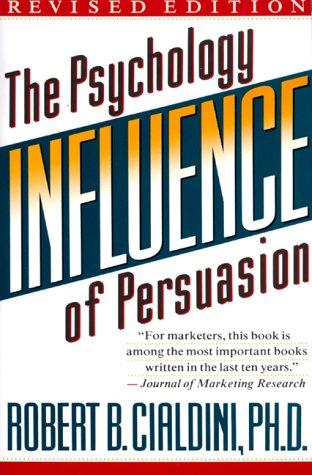
Before machines did it at scale, Cialdini mapped why a trusted recommendation moves people like nothing else. Read the mechanism, then watch it run in your market.
View on Amazon